

India inaugurated Pune’s ₹8,300-crore Metro Line 3 on Tuesday, with passenger services scheduled to begin today at 17 of its 23 stations. The telecom regulator issued new rules requiring operators to modernise network interconnections, while the Health Ministry proposed stricter accountability for releasing pharmaceutical batches. Off Somalia, the Indian Navy reported rescuing 20 crew members from a hijacked fishing vessel. Indian equities also extended their rally for a fourth consecutive session. ¹ ³ ⁴ ⁵
“Our cities are not merely residential spaces, they are major centers of the nation’s economic activity.” — Prime Minister Narendra Modi, 3 November 2026, official statement.
The latest developments bring several kinds of public investment and regulation into focus. Pune’s newest Metro corridor is moving from construction to passenger operations, while its planned extensions remain years from completion. Telecommunications providers face a phased technology transition. Drug manufacturers may face new documentation requirements, subject to consultation. In each case, the immediate announcement is only one stage of implementation.
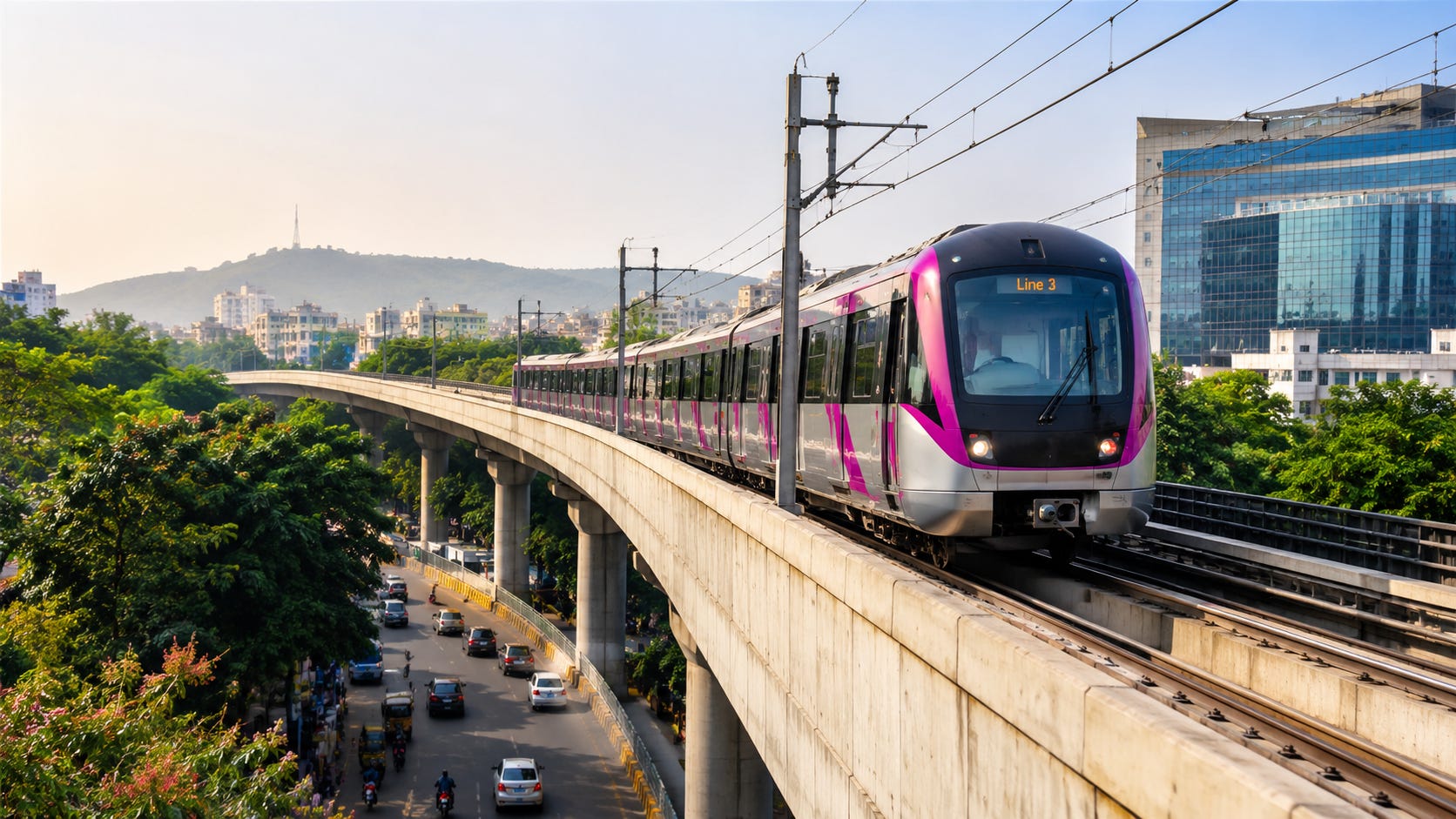
Pune inaugurates Metro Line 3; services begin today
Key facts
Line 3 investment: Approximately ₹8,313 crore.
Length: 23 kilometres.
Initial opening: 17 of 23 stations.
Additional projects: Approximately ₹13,500 crore in proposed Phase-II corridors.
Prime Minister Narendra Modi inaugurated Pune Metro Line 3 on 3 November and laid foundation stones for further corridors. The combined value of the inaugurated line and proposed extensions is approximately ₹21,800 crore. ¹
The distinction between those projects is important.
The 23-kilometre Pink Line connects Maan and the Hinjewadi technology district with Shivajinagar. Passenger services are scheduled to begin on 4 November, initially serving 17 stations.
Six stations remain unavailable during the first stage. Authorities expect two to open later in November and the remaining four in phases by January 2027.
The corridor has been developed through a public-private partnership involving Pune IT City Metro Rail Limited, associated with Tata and Siemens. It is designed to connect with Pune’s existing Metro network at District Court. ²
The foundation stones laid on Tuesday concern four additional corridors: Lines 2A, 2B, 4 and 4A. Their estimated ₹13,500-crore cost represents planned investment, not expenditure on completed infrastructure.
Analysis: The immediate test for Line 3 is passenger usage and service reliability. The corridor could improve access to Pune’s technology and employment districts, but its contribution to reducing road congestion will also depend on station access, feeder transport and how many commuters switch from private vehicles.
Next milestone: Passenger operations begin on 4 November. Completion of the remaining six stations is planned in phases through January 2027.
TRAI gives operators three years to modernise network interconnections
Key facts
Regulations issued: 3 November 2026.
Effective date: 1 January 2027.
Technology transition: New interconnections must use IP-based systems.
Migration period: Three years for existing arrangements. ³
The Telecom Regulatory Authority of India has issued amendments governing how competing telecommunications networks connect and exchange traffic.
Interconnection allows subscribers of different operators to communicate. The underlying arrangements affect network reliability, routing and the technical cost of carrying calls.
Under the new regulations, all interconnections established after the rules take effect must use internet protocol-based technology.
Existing interconnections using older E1 and time-division multiplexing systems must migrate to IP-based systems within three years.
The regulator is also moving towards interconnection at the Licensed Service Area level, replacing the older framework based on smaller charging areas.
Operators will be able to agree on interconnection locations within the revised rules. TRAI expects the changes to simplify routing, improve bandwidth efficiency and support network reliability.
The amendments introduce reporting obligations and a graded framework of financial disincentives for non-compliance.
Analysis: This is primarily an infrastructure and competition measure, rather than an immediate change in consumer tariffs. Its effectiveness will depend on coordination between operators and the reliability of migrated connections.
Next milestone: The rules become effective on 1 January 2027. Operators then face phased migration requirements extending over three years.
Health Ministry proposes stronger controls on drug batch release
Key facts
Proposal: Amendments to the Drugs Rules, 1945.
Requirement: A formally authorised, qualified person responsible for batch release.
Documentation: Prescribed batch-release records and certificates.
Status: Draft rules, open to objections and suggestions. ⁴
The Union Health Ministry announced proposed amendments on Tuesday that would require pharmaceutical manufacturers to formally designate qualified personnel to authorise the release of manufactured drug batches.
Batch release is the quality-control decision made before medicines are cleared for distribution.
Manufacturing licences already require details of competent technical staff responsible for production and testing. The Ministry says the existing rules do not expressly require manufacturers to identify the person authorised to make the final batch-release decision.
The proposed framework would introduce that responsibility and require manufacturers to maintain prescribed records, including a Batch Release Certificate.
The Ministry says the changes are intended to strengthen traceability and accountability while supporting compliance with Good Manufacturing Practices.
They have not yet become final operational requirements. The draft remains subject to the prescribed consultation process.
Analysis: Clear responsibility for approving batches could strengthen regulatory oversight, particularly when quality failures require investigators to reconstruct manufacturing and testing decisions. The practical benefit will depend on record accuracy, regulatory inspections and enforcement.
Next milestone: Review of stakeholder submissions and publication of any final amendments in the Official Gazette.
Indian Navy reports rescue of 20 crew from hijacked vessel off Somalia
Key facts
Vessel: Fishing vessel Azini.
Location: Waters off northeastern Somalia.
Operation: More than 48 hours.
Rescue: 20 crew members, according to the Indian Navy. ⁵
The Indian Navy announced on Tuesday that it had secured the hijacked fishing vessel Azini and rescued its crew following an operation involving a deployed warship, maritime surveillance aircraft and naval commandos.
The vessel had reportedly been seized by armed pirates in late October.
Indian authorities said they were concerned it could be used as a mother ship—a larger vessel supporting attacks against commercial shipping farther from shore.
According to the Defence Ministry, an Indian Air Force C-17 aircraft helped reinforce the operation by deploying additional Marine Commandos.
The Ministry reported that all 20 crew members were rescued without casualties.
Independent reporting has raised discrepancies over the vessel’s original complement and the subsequent handling of suspected pirates. Those details require further clarification. ⁶
Analysis: The operation highlights India’s maritime-security role beyond its territorial waters. Renewed piracy threatens shipping routes already exposed to conflict-related disruption, higher insurance costs and operational uncertainty.
Next milestone: Further information from Indian and regional authorities on the incident, the suspected pirates and arrangements for the rescued crew.
The day ahead
Pune Metro: Line 3 begins its first day of scheduled passenger services, with 17 stations initially available.
Indian economy: The final October services PMI is scheduled for release. It will offer another indicator of private-sector activity after manufacturing growth moderated in October.
Markets: The Nifty 50 closed Tuesday at 23,810.85, up 1.58%, while the Sensex ended at 76,917.85, up 1.62%. Investors remain attentive to oil prices, corporate earnings and overseas developments. ⁷
United States: Results from the 3 November midterm elections remain in focus, with potential implications for US fiscal, trade and foreign policy.
5 November: The Bharat Renewable Energy Summit concludes in New Delhi.
6 November: The Reserve Bank of India’s next weekly foreign-exchange reserve figures are expected.
Explore The Raisina Post
Our public research tools provide additional context to the day’s developments.
Market Desk — Indian equities, currencies and commodity reference data.
Policy Monitor — Regulatory announcements and official government records.
India in Data — Economic indicators and historical comparisons.
Sources
Prime Minister’s Office, Pune Metro Projects Worth Approximately ₹21,800 Crore, 2–3 November 2026. Official release
The Indian Express, PM Inaugurates Pune Metro Line 3, 3 November 2026. Read
Telecom Regulatory Authority of India, Telecommunication Interconnection (Third Amendment) Regulations, 2026, 3 November 2026. Original regulatory publication
Ministry of Health and Family Welfare, Proposed Amendments to the Drugs Rules, 1945, 3 November 2026. Official announcement
Ministry of Defence, Indian Navy Rescues Fishing Vessel Azini, 3 November 2026. Official announcement
Associated Press, Indian Navy Rescues Crew from Hijacked Iranian Fishing Boat, 4 November 2026. Read
Reuters, Indian Shares Extend Rally as Earnings and Cooling Crude Draw Foreign Buyers, 3 November 2026. Read
Information cutoff: Approximately 8:40 a.m. IST, 4 November 2026.
Reporting note: This briefing draws on official government and regulatory publications, published economic and market data, and attributed journalism. It does not include independent interviews. Proposed measures and scheduled activities are distinguished from rules already in force and completed operations.

The next briefing, in your inbox
The Raisina Post’s Editorial Desk sends a clear account of the decisions, data and global moves shaping India each morning. Subscribe free, or share this edition with someone who follows the story.